
In the summer of 2025, the world is experiencing a “synchronous heatwave attack.” The impacts are being felt across the globe, from the agricultural sectors in Japan and South Korea to the wildfires in Europe and the United States, and the record – breaking high temperatures in Northern Europe.
On July 28, the World Meteorological Organization (WMO) issued a global heatwave alert. Spokesperson Clare Nullis stated that in the future, humanity will have to learn to adapt to more frequent and intense heatwaves caused by climate change and find ways to co – exist with them.
Japan Faces “Rice Shortage” and South Korea “Vegetable Shortage”
On August 5, according to the Japanese meteorological department, the city of Isezaki in Gunma Prefecture, Japan, recorded a high temperature of 41.6 degrees Celsius on that day, setting a new national record. In Japan, the continuous high temperatures are beginning to affect crops and livestock. According to a report by the Nikkei Asian Review on August 3, vegetable prices in Japan are rising, and the price of domestic pork has reached a 50 – year high.
Compared with vegetable prices, Japanese people are more concerned about rice production. In recent years, the situation of “rice shortage” in Japan has continued. The Japanese government has taken various measures such as releasing “reserve rice” to balance rice prices. Now, due to high temperatures, more and more rice fields in Japan are suffering from drought, cracking, and pest infestations. The output of new rice in Japan this year is still not optimistic.
Similarly, in South Korea, the prices of some agricultural products are soaring due to extreme weather. The latest data from the Korea Agro – Fisheries & Food Trade Corporation shows that the average retail price of an approximately 8 – kilogram watermelon in the Korean market is currently 33,337 won (about 173 yuan in RMB), nearly 20% higher than the same period last year. The average retail price of tomatoes is 6,716 won per kilogram (about 35 yuan in RMB), a year – on – year increase of 42.6%. The price of Chinese cabbage is of particular concern.
Due to the continuous high temperatures and rare heavy rains since the beginning of summer this year, the average retail price of Chinese cabbage in South Korea has reached 6,114 won (about 32 yuan in RMB), an increase of 68% compared to a month ago. Korean media said that as the most widely used raw material for kimchi, the “lifeblood” of Korean cuisine, the price of Chinese cabbage not only directly affects the cost of living but also has a knock – on effect in other areas.
Wildfires Rage in Many Countries in Europe and America
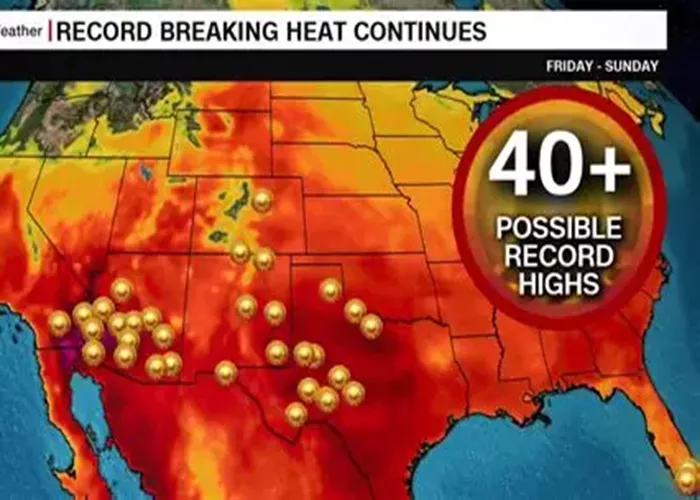
This year’s extreme heat, combined with strong winds and drought, has triggered catastrophic wildfires in many parts of the world, especially in the western United States and southern Europe.
Since July, wildfires have broken out successively in California, Arizona, and Utah in the western United States, some of which have been burning for more than a month. The forest fires in Arizona have become one of the largest wildfires in the contiguous United States, and Utah has declared a state of emergency. Pyrocumulus clouds have made fire – fighting extremely difficult, and the is difficult to control. Some communities have been evacuated urgently, and power facilities have also been affected.
At the end of July, wildfires broke out in many places in Spain and Portugal on the Iberian Peninsula and continued to rage for many days. In early August, Spain and Portugal also have a second wave of heatwaves, with temperatures exceeding 40°C in many places. Portugal declared a state of alert on August 3 due to high temperatures and wildfire risks.
On August 5, a large – scale forest fire occurred in the Aude department in southern France. By the evening of the same day, the burned area had reached 8,000 hectares, and the fire was still not under control. French President Emmanuel Macron expressed concern about the wildfire through social media that evening, saying that the country had gone all out to respond.
Northern European Countries Troubled by High Temperatures
Global warming has intensified the intensity and duration of hot weather. Northern Europe has been continuously hit by extreme high temperatures this summer. The Nordic countries, known for their cold climates, are being baked by an “unprecedented” heatwave. According to a report by The Guardian on August 4, a weather station within the Arctic Circle in Norway recorded temperatures above 30°C for 13 days in July, and Finland has had temperatures above 30°C for three consecutive weeks.
The infrastructure in these cold – climate countries and regions is not adapted to high – temperature environments. According to Finnish media reports, an ice rink in northern Finland was opened for people to escape the heat, and local hospital emergency rooms were overcrowded. Reindeer herders have warned that their reindeer are on the verge of dying in the heat.
The ecological environment in the Antarctic region has also been widely affected. A research report recently released by Monash University in Australia shows that since 1947, about 64 square kilometers of glaciers on Heard Island in the sub – Antarctic region have melted and disappeared, accounting for about 23.1% of the island’s original total glacier volume, nearly a quarter.
From the Arctic Circle to the Mediterranean, humanity is jointly experiencing a silent “roasting test” within the territory swept by the heatwave. Extreme high temperatures are no longer rare but have become the new normal faced by all of humanity. The United Nations issued a call in July this year for all parties to take action to jointly address the impacts of extreme high temperatures, stating that “the Earth is getting hotter and more dangerous, and no country can be spared.” From individuals to systems, how to formulate strategies to deal with the challenges of high temperatures will become a common issue for everyone in the future.
Related topics:
E-cigarette Crisis: A Nightmare for Singaporean Parents
UCLA Scientists Breakthrough: Stem Cells for Sustained Anti-Cancer T Cells
Novo Nordisk’s Semaglutide Shows Promise for Obesity, Heart Health
