
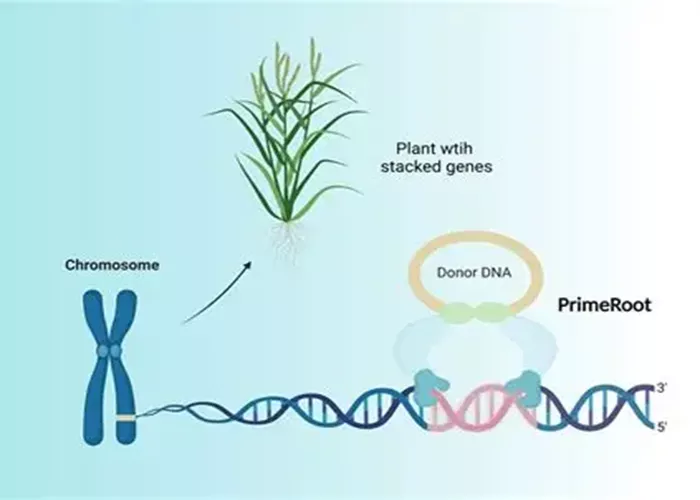
In a significant advancement for life sciences, while genomic editing technologies have enabled precise modification of short DNA fragments, editing large – scale DNA segments has remained a challenge. On the evening of August 4th, a research team led by Gao Caixia from the Institute of Genetics and Developmental Biology, Chinese Academy of Sciences, published a paper in the international journal Cell. The study details a novel programmable chromosome – level large – scale DNA precise manipulation technology named PCE, which achieves “precise editing” of DNA ranging from kilobases to megabases in eukaryotic genomes.
Reviewers lauded this work as a major breakthrough in genetic engineering, with great potential for applications in breeding and gene therapy. DNA, the code of life, stores genetic information that determines an organism’s traits, life activities, and even the direction of evolution. Currently, the CRISPR and its derivative technologies, known as “gene scissors”, are widely used in specific base and short – fragment DNA editing. However, precisely manipulating thousands to millions of bases is the core challenge in large – scale DNA editing. Existing tools have obvious limitations in editing efficiency, scale, precision, and diversity of editing types.
The research team developed a new method for precise and scar – free editing of ultra – large DNA fragments, constructing two programmable chromosome editing systems, PCE and RePCE. These systems enable precise and scar – free manipulation of ultra – large DNA fragments, successfully cracking the “scale dilemma” in genome editing. Gao Caixia, a researcher at the Institute of Genetics and Developmental Biology, Chinese Academy of Sciences, introduced that this technology can achieve multi – type precise manipulation of DNA at the megabase level in plant and animal cells, significantly enhancing the manipulation scale and capacity of eukaryotic genomes.
Three Innovations Break through Technical Bottlenecks
The site – specific recombinase Cre – Lox system has the potential for chromosome – level DNA manipulation. However, its further application is restricted by three key issues. To address these, the research team established a systematic technical approach, achieving three key technical innovations that act as a “navigation system” for precise and scar – free editing of ultra – large DNA fragments.
“Two – way Door” Transformed into “One – way Passage”
To solve the problem of reversible recombination reactions caused by the inherent symmetry of Lox sites, the research team innovatively developed a high – throughput rapid modification platform for recombination sites. They successfully created a new Lox variant, which is like a one – way turnstile gate, allowing DNA fragments to move only in a predetermined direction, thus being more conducive to the occurrence of the desired editing.
“Team Optimization” of Cre Recombinase with the Aid of Artificial Intelligence
Simply put, Cre recombinase is like a transporter of DNA fragments. Based on the artificial intelligence – based novel protein directed evolution method AiCE independently developed by the research team previously, the researchers precisely optimized the Cre protein multimerization interface. As a result, an engineered Cre protein variant with a 3.5 – fold increase in recombination efficiency was obtained, effectively enhancing its activity and “work efficiency”.
Creation of the “Scar – free Editing Strategy” Re – pegRNA
To avoid the interference of residual specific sites after recombination on the precision of genome editing, the Re – pegRNA strategy developed by the research team is like an intelligent eraser. It can accurately identify and eliminate these residual sites, improving editing precision.
Promising Applications in Multiple Scenarios
Industry insiders believe that the new method for precise and scar – free editing of ultra – large DNA fragments can open up new paths for crop trait improvement and genetic disease treatment by manipulating genomic structural variations.
In traditional breeding, favorable traits are often genetically linked to unfavorable genes, similar to a “bundled sale”. The breakthrough in precise and scar – free editing of large – scale DNA fragments is expected to promote the development of new breeding strategies. For example, by manipulating genetic linkages and regulating recombination frequencies, fertility control can be achieved, and linkage drag can be eliminated, fully unleashing the breeding potential of excellent alleles in wild germplasm resources. Currently, the research team has successfully created a herbicide – resistant rice germplasm with a precise 315 – kilobase inversion using this technology.
In the field of genetic disease treatment, this technology is expected to provide new treatment ideas for diseases caused by chromosomal abnormalities. In addition, the breakthrough in precise chromosome editing technology will accelerate the construction of artificial chromosomes, holding great promise for emerging fields such as synthetic biology.
Related topics:
12 Holistic Health Tips to Naturally Improve Erectile Dysfunction Symptoms
Top Testosterone Boosters of 2025 Spotlighted at Health Events
Legionnaires’ Outbreak in NYC Causes 58 Illnesses, 2 Deaths, Health Alerts
