
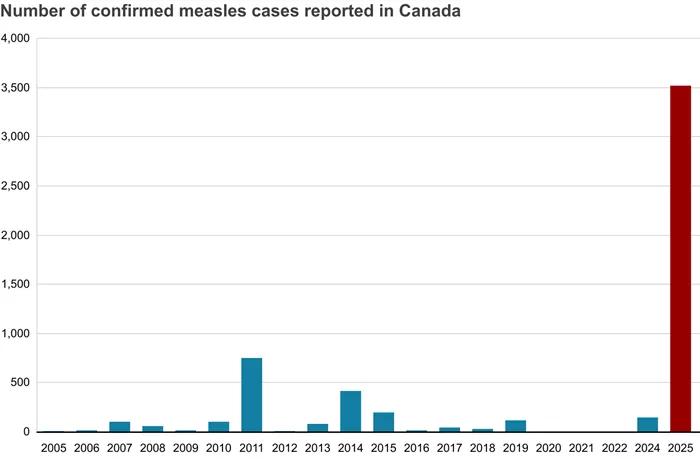
In 2025, Canada has unexpectedly found itself at the epicenter of one of the largest measles outbreaks in the developed world, reporting over 3,800 cases—surpassing even the United States despite its smaller population. The outbreak has raised alarm among public health experts who once believed the disease had been effectively eliminated in the country.
The surge in infections has struck hardest in Alberta and Ontario, with Manitoba also seeing rising cases. Alberta currently holds the highest per capita rate of measles infections in North America, a troubling indicator of a wider public health issue unfolding across Canada.
The rapid rise in cases has shocked many Canadians, especially parents like Morgan Birch, whose four-month-old daughter, Kimie, contracted measles after a routine hospital visit. Initially misattributing Kimie’s fever and rash to vaccinations or chickenpox, Birch was stunned when a lab test confirmed measles—an illness her family thought belonged to the past.
Understanding the Source of the Outbreak
The initial wave of the outbreak in Ontario began in late 2024, linked to a large religious gathering in New Brunswick. From there, measles spread rapidly through Low German-speaking Mennonite communities in southwestern Ontario, where vaccine hesitancy is more common due to cultural and religious beliefs.
Although many members of these communities support vaccination, certain conservative groups have historically been more skeptical of immunization and less engaged with public healthcare systems. Nearly all of those infected in this outbreak were unvaccinated.
As the virus spread from community to community, a new epicenter formed in Alberta. In some regions, the transmission was so rapid that health officials couldn’t trace its origin. In southern Alberta alone, over 1,300 cases have been reported since March, and the region has recorded over 100 hospitalizations. Even more concerning, at least six infants were born with measles after their mothers were exposed during pregnancy.
Healthcare workers serving these communities note a deepening mistrust in the medical system, exacerbated by experiences of discrimination and a wave of anti-vaccine misinformation that intensified during the COVID-19 pandemic. Some individuals now associate all vaccines with government overreach or perceive them as unsafe—a sentiment that has expanded since the controversial COVID vaccine mandates.
The Role of Vaccine Hesitancy
While there is no single cause behind the outbreak, the overarching issue is clear: declining immunization rates. In Alberta, MMR vaccination rates for children dropped nearly 50% between 2019 and 2024. Nationally, coverage for the first dose of the measles vaccine has fallen from over 90% in 2019 to about 83% in recent years—well below the 95% threshold needed for herd immunity.
Public health experts attribute this decline to a mix of pandemic-related service disruptions, growing anti-vaccine sentiment, and reduced urgency among parents due to the historical rarity of measles. After decades without major outbreaks, many families no longer viewed immunization as a pressing concern.
Moreover, opposition to COVID-19 vaccine mandates in Canada—epitomized by large protests in Ottawa—has spilled over into broader vaccine skepticism, further weakening immunization efforts across the country.
A North American Concern
The measles crisis in Canada mirrors trends across North America and Europe. In the United States, more than 1,200 cases have been confirmed in 2025—the highest annual total in over three decades. Several states, including Texas and Oklahoma, are experiencing significant outbreaks, some traced back to travelers returning from Canada.
In the United Kingdom and across parts of Europe, measles cases have also surged, as pandemic disruptions and misinformation have undermined vaccine campaigns. In England alone, nearly 3,000 cases were reported in 2024, the highest total since 2012.
International health organizations have warned that the world may be losing its herd immunity to measles. Global measles deaths, once reduced by 73% through vaccination efforts, are now rising again.
Public Health Measures and Community Outreach
In response, Canadian health authorities have taken emergency measures. Alberta has lowered the minimum age for MMR vaccination from 12 months to 6 months in high-risk areas. Clinics have been deployed to underserved rural regions, and public campaigns—including radio ads and mobile alerts—are urging families to catch up on missed vaccinations.
Despite these efforts, health workers on the ground report muted responses compared to the urgency seen during the height of the COVID-19 pandemic. Some families remain resistant or fearful of vaccines, and misinformation continues to circulate widely, particularly on social media platforms.
Efforts are now being made to rebuild trust by working directly with local leaders in hesitant communities and emphasizing the role of vaccines in protecting the most vulnerable—especially infants too young to be immunized.
