
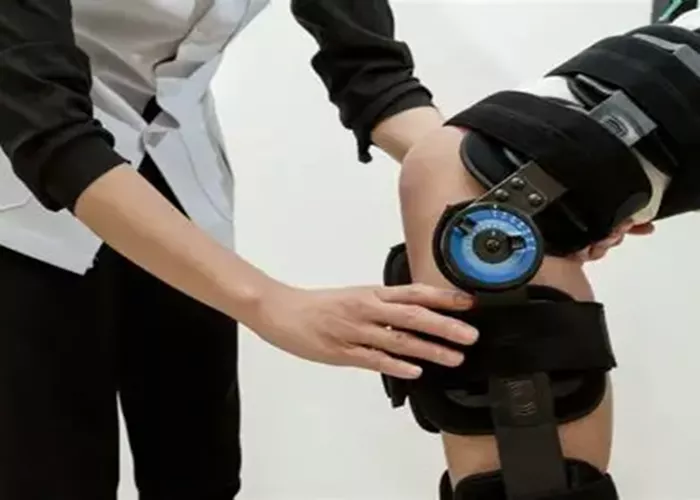
A research team from the Massachusetts Institute of Technology (MIT) has developed a new – generation “bionic knee” prosthesis, which enables above – knee amputees to walk faster and perform complex tasks such as climbing stairs and crossing obstacles more easily compared to traditional prostheses. This achievement, published in the latest issue of the journal Science, marks a significant leap in prosthesis technology from passive assistance to active sensing and intelligent control.
Traditional prosthetic systems place the residual limb in a socket, while the new device integrates directly with the user’s muscle and bone tissues. This integration enhances stability and allows for more natural control of the prosthesis, making it feel like a part of the user’s own body. The team noted that this “tissue – integrated prosthesis” is not just an external tool but a smart device highly integrated with the human physiological system, giving users a stronger sense of “limb ownership”.
The innovation of this system lies in the combination with a new surgical method called the agonist – antagonist myoneural interface (AMI). This method reconnects muscle pairs through surgery, enabling them to maintain dynamic interaction within the residual limb, providing sensory feedback, and generating electrical signals that can be used to control the prosthesis. On this basis, the team developed an integrated system that can not only read the signals from AMI muscles but also implant the prosthesis into the bone structure, achieving higher – stability and more precise motion control.
The team designed a titanium rod implantation technique, inserting it into the residual femur of the amputation site. This implant not only improves mechanical control and load – bearing capacity but also has 16 built – in wires, which can obtain information from the AMI muscle electrodes in the body, more accurately capturing muscle signals and converting them into prosthesis movements.
This integrated system is named e – OPRA (electrical osseointegrated prosthesis system). In the experiment, two subjects received AMI combined with e – OPRA implantation. The team compared their performance with that of eight users who only received AMI but did not implant e – OPRA and seven users who had neither AMI nor e – OPRA. All participants were tested using a power – knee prosthesis developed in the laboratory.
The test content included tasks such as bending the knee to a specified angle, climbing stairs, and crossing obstacles. The results showed that the subjects using the integrated system performed better than the other two groups in most tasks, especially having more obvious advantages in tasks requiring fine control and dynamic balance.
The development of this bionic knee prosthesis is expected to bring new hope and better quality of life to amputees, and it also opens up new prospects for the future development of prosthesis technology.
Related topics:
OTC Depression Treatments Reviewed: What Works and What Doesn’t
EU faces pressure to regulate sperm and egg donations
Menopause Hormone Therapy Enhances Obesity Drug’s Effectiveness in Women
