
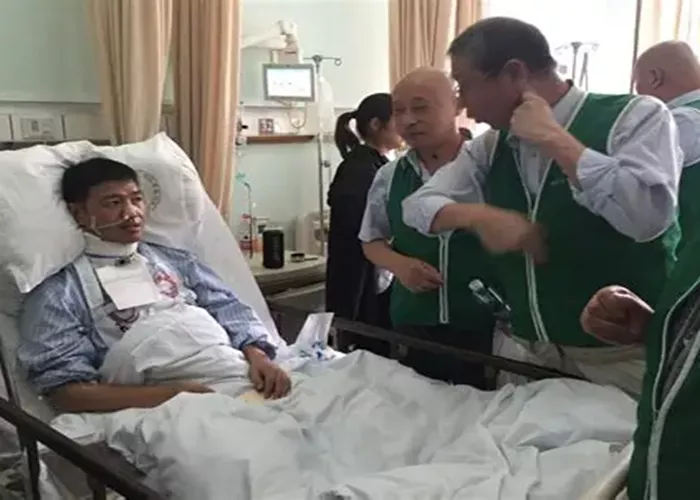
On July 15th, Chongqing University Cancer Hospital announced that all 8 laryngeal cancer patients from across China who participated in its esophageal voice training program successfully regained speaking ability after two weeks of systematic training, achieving a 100% success rate.
“Good morning, everyone!” On the third day of training, Mr. Chen, a 51-year-old participant, greeted the medical staff with a clear and loud voice, leaving his family members tearful. Diagnosed with advanced laryngeal cancer in 2024, Mr. Chen underwent total laryngectomy—the optimal treatment for his condition—but the surgery meant permanent loss of his natural voice.
“Patients like Mr. Chen, who hesitate about surgery due to fears of losing the ability to speak, are not uncommon in clinical practice,” said Wu Jian, director of the Head and Neck Oncology Department at the hospital. He explained that total laryngectomy is a critical treatment for advanced laryngeal cancer, hypopharyngeal cancer, and other severe diseases. However, the loss of natural voice not only hinders communication but also profoundly impacts patients’ mental health, social integration, and quality of life.
Natural human speech relies on vocal cord vibrations in the larynx: air passing through the vocal cords causes vibrations, which then form language through resonance in the mouth and nose. Since total laryngectomy removes the larynx, including the vocal cords, patients can no longer speak traditionally. Fortunately, advances in medical rehabilitation now allow such patients to regain speech through scientific training.
“Esophageal voice uses the mucosa of the hypopharynx and upper esophagus as a new glottis. By adjusting esophageal pressure through inhaling and exhaling, combined with articulatory organs like the mouth and pharynx, language is formed,” Wu Jian explained. He added that once patients master the technique, they can restore natural-sounding speech without relying on devices through repeated practice.
Emphasizing the “prevention, screening, diagnosis, treatment, and rehabilitation” framework in cancer care, Wu Jian stated that the hospital aims not only to cure the disease but also to help patients reintegrate into society. They have built a full-cycle management model covering “screening, assessment, diagnosis, rehabilitation, monitoring, and follow-up,” supporting patients in transitioning from “disease cured” to “life regained” with medical and humanistic care.
To date, the hospital has held 11 sessions of esophageal voice training, helping over 100 “larynx-less” patients speak again. This year, it pioneered a training program for esophageal voice instructors, enrolling 5 medical professionals from hospitals in Sichuan, Guangxi, and Chongqing to systematically master the skill. “We hope more medical staff will learn this technique to help more patients regain their ‘new voice,'” Wu Jian said.
Related topics:
OTC Depression Treatments Reviewed: What Works and What Doesn’t
EU faces pressure to regulate sperm and egg donations
Menopause Hormone Therapy Enhances Obesity Drug’s Effectiveness in Women
