
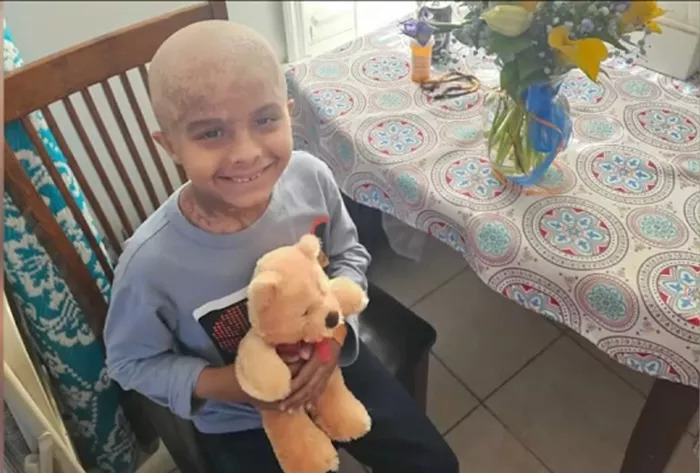
An 8-year-old boy diagnosed with a rare and often deadly genetic condition has shown remarkable recovery after receiving an experimental treatment, never before tested in humans.
Just months earlier, his health had rapidly declined. In August 2023, he was running and playing soccer. By September, muscle spasms affected his ankles. By October, he could no longer run. And by November, he needed a wheelchair due to frequent falls.
Doctors at NYU Langone Health discovered that he had two mutated copies of a gene called HPDL. This gene helps the body produce coenzyme Q10 (CoQ10), an antioxidant that powers cells and is crucial for the brain and muscles. His diagnosis followed the deaths of two of his siblings, who had earlier died from a more severe form of the same condition during infancy.
When Dr. Claire Miller, a pediatric neurologist, first met the boy in late 2023, he could barely walk across a hospital lobby. His condition was worsening each week.
But after getting emergency approval from the U.S. Food and Drug Administration (FDA), the child began taking an experimental drug that aims to bypass the missing HPDL protein. Scientists believe the treatment helps the body make CoQ10 even without the faulty gene.
Within weeks, the boy was walking through Central Park with his family. Today, he has hiked 4 miles and can drive a go-kart. His parents said in an email, “Even small improvements — like walking more easily or having more energy — mean a lot. It’s reassuring to know the treatment is making a difference.”
So far, the daily oral medication has not caused any serious side effects. His medical team now hopes to test it in more children with HPDL deficiencies and possibly expand trials to other related mitochondrial conditions.
The treatment was developed by Dr. Michael Pacold’s lab at NYU’s Perlmutter Cancer Center. Earlier studies on mice with a condition similar to the boy’s showed promising results.
The HPDL protein starts a chemical process that helps create CoQ10. Without it, the body can’t make enough of this vital antioxidant. CoQ10 is critical not just for energy production but also for protecting cells from damage — especially in high-demand organs like the brain and muscles.
Pacold’s team showed that feeding mice with two chemical compounds — 4-HMA and 4-HB — helped bypass the missing HPDL step. In the lab, baby mice with HPDL deficiency typically died within 15 days. But with early treatment, 90% of them survived over 18 months and had only mild symptoms.
Those results gave Dr. Miller the confidence to try the approach with the child. “The risk of trying this, although hard to measure, seemed low,” she said. “And the potential benefit was huge.”
The child receives only 4-HB dissolved in water. It was chosen because it’s already available in highly pure form. He finds it sour and prefers it cold — but it’s manageable, his doctor says.
Since beginning the treatment in December 2023, he’s regained almost all of his daily functions except for full participation in sports. His family said, “He practically is able to do all daily functional activities by himself except sports.”
Experts who reviewed the trial said the early success is encouraging. Dr. Siegfried Hekimi, a biologist at McGill University not involved in the study, said the results show the treatment helps both mice and humans. But he also noted it’s not yet clear if the benefit comes from restored CoQ10 levels or from other effects of the treatment.
“It may be that 4-HMA and 4-HB help in other ways we don’t fully understand yet,” Hekimi said.
The study, published in Nature on July 9, emphasizes that much more research is needed. The current data comes from just one human patient.
Pacold agreed, saying, “The next step is to test this in more patients and see if others respond the same way.”
Still, Miller remains hopeful.
“We all know that research does not always turn out as one hopes,” she said. “But this is a really happy story. A child became very sick in a short time — and now he’s doing so much better.”
READ MORE
Simple Shower Habits Are Best, Say Skin Health Experts
RFK Jr. Praises Food Company Despite Its Ultraprocessed Meals
