
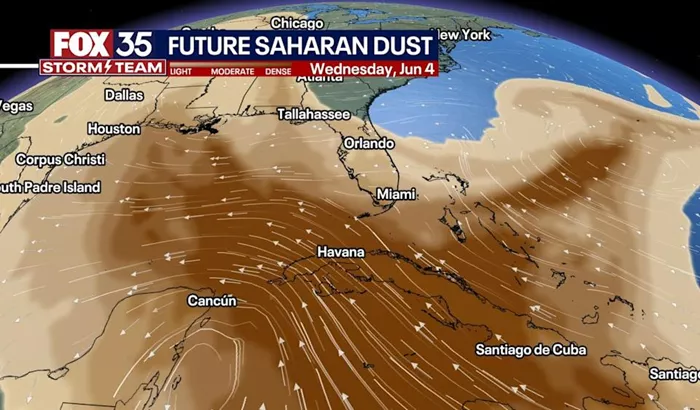
A large cloud of Saharan dust is moving across the Atlantic Ocean and is expected to reach Florida by Saturday. This weather event could affect air quality, visibility, and even your health. Here’s a closer look at what Saharan dust is and what it means for those in its path.
What Is Saharan Dust?
Saharan dust is made up of fine sand and mineral particles from the Sahara Desert in North Africa — the world’s largest hot desert. Every year, strong winds lift this dust into the air and carry it across vast distances, even as far as the Americas.
This process is driven by the Saharan Air Layer, a dry, dusty mass of air that forms over the desert from late spring through early fall. The National Oceanic and Atmospheric Administration (NOAA) says these dust events are most active from mid-June to mid-August.
Dust outbreaks often start when atmospheric disturbances stir up the sand. Once airborne, the dust can travel thousands of miles, sometimes reaching areas like Texas and Florida.
What’s Happening Now?
Earlier this week, people in Puerto Rico and the U.S. Virgin Islands experienced hazy skies due to Saharan dust. Now, that same plume is moving toward Florida. Meteorologists say the dust will reach central and southern parts of the state by the weekend and could stay for several days.
A denser wave of dust is expected by the middle of next week. As it spreads, the dust will likely bring hazy skies, lower air quality, and limited visibility. However, it could also lead to more colorful sunsets.
Can This Dust Affect Storms?
Yes — and in a good way. One benefit of Saharan dust is that it can help reduce the formation of tropical storms and hurricanes. The dry air makes it harder for these systems to gather the moisture they need to grow. That’s especially helpful during the Atlantic hurricane season, which runs from June through November.
Is Saharan Dust Harmful to Health?
It can be. According to the Centers for Disease Control and Prevention (CDC), Saharan dust is considered “particulate pollution.” This means it contains tiny particles that can pollute the air and pose health risks.
People with asthma, allergies, heart conditions, or other respiratory issues may be especially sensitive. Older adults and children can also be at risk. The particles are so small that they can be inhaled into the lungs and even enter the bloodstream.
How Can You Stay Safe?
If you’re in an area affected by Saharan dust, here are a few ways to protect your health:
Stay indoors as much as possible, especially during high dust levels.
Wear a mask, such as a KN95, if you need to go outside.
Use an air purifier with a HEPA filter to improve indoor air quality.
Keep medication like inhalers nearby if you have a respiratory condition.
